
Article Summary
- Understand standard credit score ranges, including poor (below 580), fair (580-669), good (670-739), very good (740-799), and excellent (800+), primarily based on FICO models.
- Learn how these credit score ranges directly affect loan interest rates, approval odds, and everyday financial costs with real examples.
- Discover actionable steps to check, monitor, and improve your score within these ranges for better financial outcomes.
Understanding Credit Score Ranges: The Foundation of Your Financial Profile
Navigating credit score ranges is essential for anyone seeking loans, credit cards, or favorable rental terms. These ranges categorize your creditworthiness into tiers like poor, fair, good, very good, and excellent, primarily using models from FICO and VantageScore. FICO, the most widely used scoring system by lenders, bases scores on a scale from 300 to 850, where higher numbers signal lower risk to creditors. According to the Consumer Financial Protection Bureau (CFPB), understanding these credit score ranges empowers consumers to make informed decisions that can save thousands in interest over time.
The core factors influencing your position within credit score ranges include payment history (35%), amounts owed (30%), length of credit history (15%), new credit (10%), and credit mix (10%). Recent data from the Federal Reserve indicates that scores in the excellent range correlate with the lowest borrowing costs, while poor ranges lead to denials or sky-high rates. For instance, a borrower with a score below 580 might face credit card APRs exceeding 25%, compared to under 15% for those above 800.
Key Differences Between FICO and VantageScore Ranges
FICO dominates mortgage and auto lending, with ranges defined as: poor (300-579), fair (580-669), good (670-739), very good (740-799), and exceptional (800-850). VantageScore, used by about 40% of lenders per Experian reports, mirrors this but starts at 300-499 for subprime (poor equivalent). These subtle differences matter—check both via free services to pinpoint your standing across credit score ranges.
Real-world scenario: Imagine two individuals applying for a $20,000 auto loan. One in the good range (700) secures 6.5% APR, paying $4,200 in interest over 60 months. The other in poor range (550) gets 18% APR, totaling $12,800 in interest—a $8,600 difference highlighting why mastering credit score ranges is crucial.
To grasp your current tier, request scores from all three bureaus—Equifax, Experian, TransUnion—weekly for free. This baseline reveals gaps, like high utilization pushing you from good to fair. Financial experts recommend tracking quarterly, as shifts in credit score ranges can occur rapidly from missed payments or new accounts.
Proactive management starts here: Review statements for errors, which the Federal Trade Commission notes affect 20% of reports. Dispute inaccuracies promptly to climb credit score ranges. Pair this with budgeting to reduce debt, aligning with principles from the National Foundation for Credit Counseling (NFCC).
Expanding on strategies, diversify credit types responsibly—a mix of installment (loans) and revolving (cards) debt boosts scores by 10-20 points in good ranges. Avoid closing old accounts, preserving history length. These tactics, backed by FICO research, position you favorably within credit score ranges.
What Counts as Poor Credit? Breaking Down the Lowest Ranges
Poor credit score ranges, typically 300-579 on FICO, represent the highest risk to lenders, often resulting from delinquencies, bankruptcies, or maxed-out cards. The CFPB reports that nearly 15% of consumers fall here, facing barriers to prime products. Interest rates soar: payday loans at 400% APR or subprime cards at 30%+ APR trap borrowers in cycles.
Common triggers include 90+ day late payments (dramatic drops of 100+ points) or collections accounts. Bureau of Labor Statistics data shows lower-income households disproportionately affected, exacerbating financial stress. Yet, recovery is possible—many rebuild to good ranges in 12-24 months with disciplined habits.
Real Impacts of Poor Credit Score Ranges on Daily Life
A tenant with poor credit might pay $100+ monthly security deposits or face denials. Job applicants in finance fields undergo checks; poor ranges hinder promotions. Calculate the toll: A $10,000 personal loan at 36% APR (poor range norm) costs $6,000+ interest yearly versus $1,200 at good rates.
Action steps include secured cards (deposit = limit, reports positively), credit-builder loans, and NFCC counseling. Experian studies show secured cards lift scores 50+ points in months. Budget 50/30/20 rule: 50% needs, 30% wants, 20% savings/debt—vital for poor ranges.
- ✓ Pull free weekly reports from AnnualCreditReport.com
- ✓ Enroll in secured card programs like Discover It Secured
- ✓ Negotiate pay-for-delete with collectors
Sustained effort pays: From poor to fair in year one averages 60-80 point gains per FICO data. Pair with debt management strategies for holistic recovery.
Defining Good Credit: The Solid Middle Ground in Credit Score Ranges
Good credit score ranges (670-739 FICO) open doors to competitive rates without elite status hassles. Federal Reserve surveys show 20-25% of Americans here, enjoying auto loans at 5-7% APR and mortgages around 6%. It’s achievable from fair with 6-12 months of consistency.
Strengths: Strong payment history, utilization <30%. Weaknesses: Shorter history or recent inquiries can cap at low-good. Lenders favor this tier for reliability without overextension risks.
Financial Perks and Pitfalls of Good Credit Ranges
Prime cards offer 1-5% cashback; utilities waive deposits. But push for very good unlocks premium rewards. Scenario: $30,000 mortgage at 6.2% (good) vs. 5.8% (very good) saves $12,000 over 30 years.
| Credit Score Range | Avg. Mortgage APR | Total Interest on $300K Loan (30 Yrs) |
|---|---|---|
| Good (670-739) | 6.2% | $267,000 |
| Very Good (740-799) | 5.8% | $246,000 |
Maintain via autopay, low balances. Reference building credit history guides for tips.
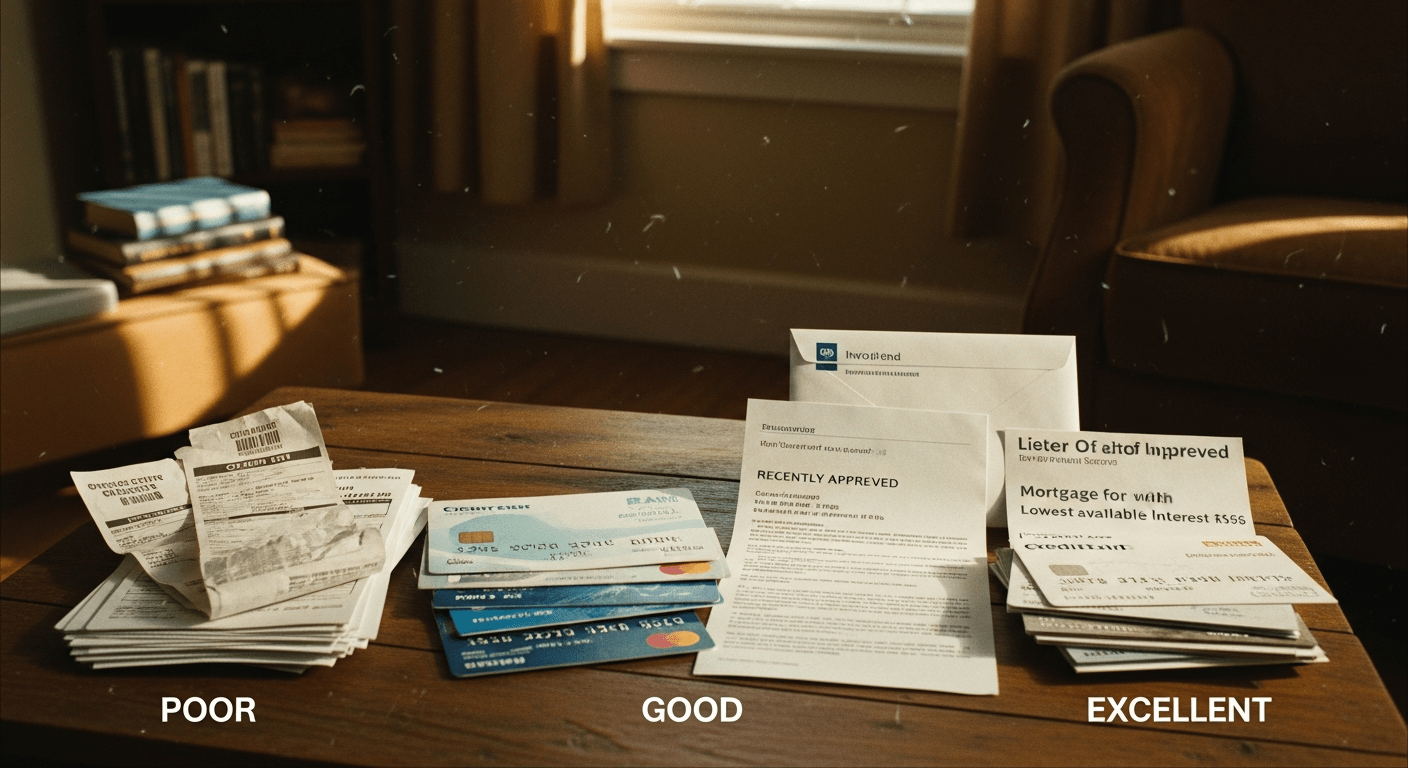
Learn More at AnnualCreditReport.com
Found this guide helpful? Bookmark this page for future reference and share it with anyone who could benefit from this financial advice!
Excellent Credit Score Ranges: Unlocking Elite Financial Advantages
Excellent credit score ranges (800-850 FICO) are held by about 20% per recent FICO data, granting top-tier perks like 0% intro APRs and waived fees. Mortgages dip to 5% APR, credit cards under 12%. The Federal Reserve notes these borrowers save 1-3% on rates versus good ranges.
Maintained by pristine history, low utilization (<10%), long accounts. Rare negatives like inquiries don’t faze lenders here.
Long-Term Wealth Building in Excellent Ranges
Lower costs compound: $50,000 refinanced at 4.5% vs. 7% saves $25,000 over 10 years. Premium rewards cards yield 2-4% returns.
Monitor via apps like Credit Karma; read credit monitoring tools for more.
Cost Breakdown
- $300K mortgage in poor range (20% APR equivalent effective cost): $1.2M+ lifetime interest.
- Good range (6.5%): $570K interest.
- Excellent (5%): $420K interest—$150K+ savings.
How Credit Score Ranges Affect Major Financial Decisions
Credit score ranges dictate outcomes across loans, insurance, rentals. CFPB data shows excellent ranges yield 50% higher approval rates. Auto insurance premiums rise 20-50% for poor scores per insurance analyses.
Loan Approvals and Rate Shopping Across Ranges
Pre-qualify without hard pulls. Poor: Subprime lenders only. Good: Multiple offers. Excellent: Best terms.
| Pros of Excellent Range | Cons of Poor Range |
|---|---|
|
|
NFCC recommends rate shopping within 14-45 days to minimize inquiry hits.
Strategies to Move Up Credit Score Ranges
Climbing credit score ranges requires targeted actions. Pay down debt first—utilization drops yield 30-50 point gains. Add positive history via authorized user status on strong accounts.
Short-Term vs. Long-Term Improvement Tactics
Short: Dispute errors (FTC: 1 in 5 have them). Long: Time heals negatives. Experian: 100-point gains possible yearly.
- ✓ Reduce balances to <10% limit
- ✓ Use Experian Boost for utilities
- ✓ Avoid >1 inquiry/quarter
Monitoring Your Position in Credit Score Ranges
Regular checks prevent surprises. Free weekly from bureaus; paid services for FICO. Federal Reserve emphasizes vigilance amid identity theft rises.
Tools and Alerts for Ongoing Management
Credit Karma/Vantage, official FICO app. Set utilization alerts. Integrate with personal budgeting tips.
Frequently Asked Questions
What are the standard credit score ranges?
FICO ranges: Poor (300-579), Fair (580-669), Good (670-739), Very Good (740-799), Exceptional (800-850). VantageScore is similar but with slight variations like 300-499 for denied.
How much does a poor credit score range cost in interest?
On a $20,000 loan, poor ranges (below 580) average 20%+ APR, adding $10,000+ interest over 5 years versus $4,000 in good ranges—a substantial premium.
Can I improve from poor to good credit score ranges quickly?
Yes, 60-100 points in 6-12 months via secured cards, on-time payments, and low utilization. FICO data supports rapid gains with discipline.
Do all lenders use the same credit score ranges?
Most use FICO, but some VantageScore. Mortgages favor FICO 8/9; check lender specifics for your credit score ranges alignment.
How often should I check my credit score within these ranges?
Weekly free via AnnualCreditReport.com; monthly via apps. CFPB recommends this to track movements across credit score ranges proactively.
What’s the biggest factor in credit score ranges?
Payment history (35%), followed by utilization (30%). Consistent on-time payments propel you up credit score ranges fastest.
Key Takeaways and Next Steps for Mastering Credit Score Ranges
Grasp credit score ranges to optimize finances: Aim above 670 for solid perks, 740+ for elite. Track weekly, act on factors. Savings compound—hundreds monthly into thousands yearly. Explore credit card rewards in good ranges.